The 5 Worst Survey Questions (And Why They're Quietly Destroying Product Feedback)


We've all filled out a survey and thought: "Wait, that's not really a question - that's a trap."
Whether it was the hotel that wanted to know how "fantastic" their breakfast was, or the airline polling you about their service while your flight sat on the tarmac for three hours, bad survey questions are everywhere. And if you're building SaaS products, running customer success, or leading a product team - there's a good chance a few of these have snuck into your own feedback stack without you even realizing it.
Here's the uncomfortable truth: bad survey questions don't just give you no data. They give you confident, wrong data. You act on it. You build roadmaps around it. You present it to leadership. And only much later - when churn ticks up or NPS quietly flatlines - do you start to wonder if the signal was ever real.
So let's call them out. The five worst survey questions, why they fail you, and what to do instead.
#1: The Leading Question
"How helpful was our outstanding customer service team today?"
The answer is already in the question. The team was outstanding. The only reasonable response is to confirm it was, in fact, outstanding—because the question has pre-decided that for you.
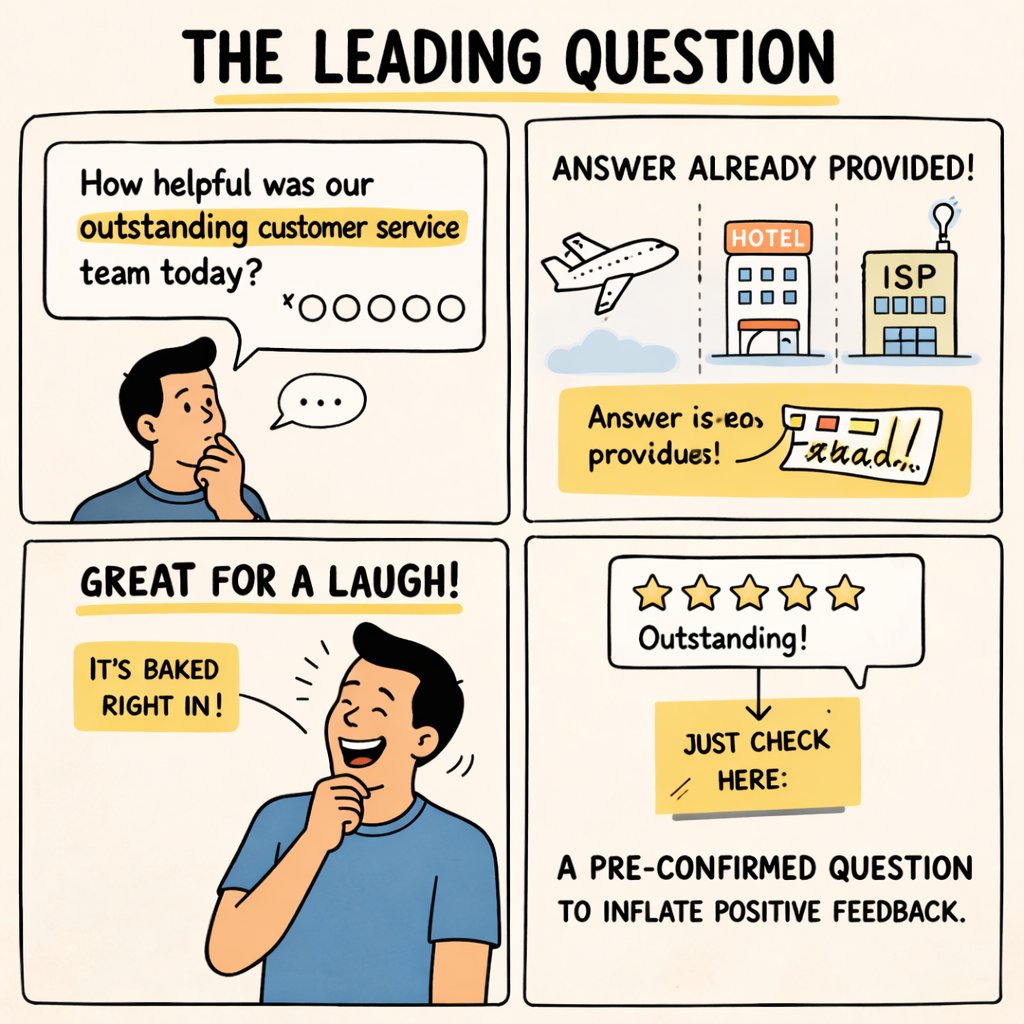
Leading questions are flattery dressed up as research. They feel good to write, they produce high scores, and they tell you absolutely nothing useful. Airlines, hotel chains, and customer service-heavy SaaS companies are particularly prone to this one. If you've ever stared at a five-star survey and thought "well, I guess it was fine," you've been on the receiving end.
The fix: Neutral language. "How would you rate your experience with our support team today?" Same question, honest answer. Or skip the leading altogether - let Elvin ask the questions, and let your users actually surprise you. Try Product Fruits now - for free!
#2: The Double-Barreled Question
"How satisfied are you with the price and quality of our product?"
Here's a scenario: the price is too high, but the product is genuinely excellent. How do you answer that on a 1–5 scale? You can't - not honestly. One answer is being forced to cover two completely different dimensions of your experience, and wherever you land, it's going to be a compromise that means nothing.
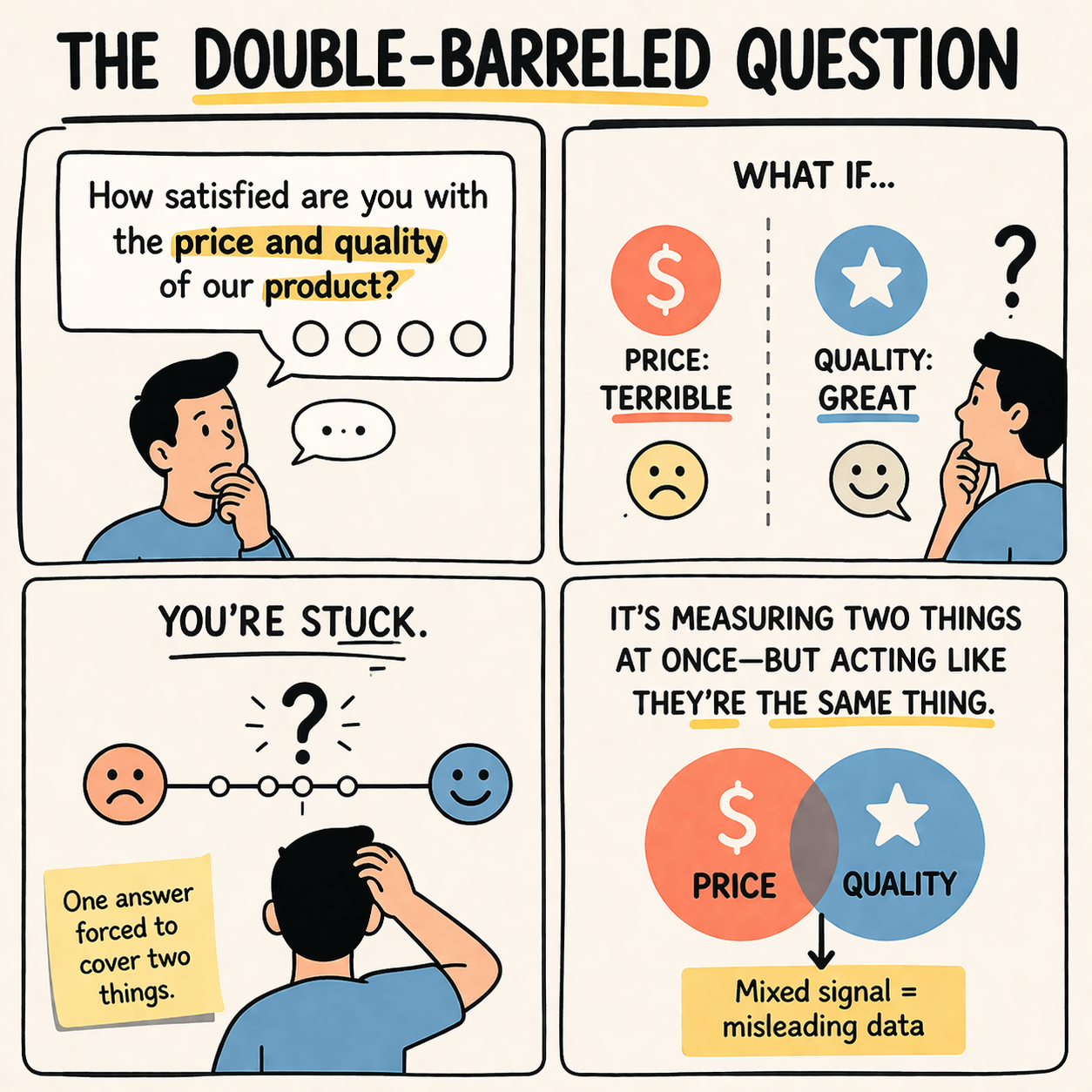
This one is particularly sneaky because it looks like a perfectly reasonable question. It's tidy. It's efficient. It saves space in your survey. And it produces data that is, at best, a blurry average of two things that probably need to be measured separately.
Mixed signal = misleading data. Always split into two questions. Or just ask Elvin to handle it. One conversation, two insights, zero awkward compromises. Try Product Fruits now - for free!
#3: The Loaded Assumption
"How did our product help you achieve your goals this month?"
This question assumes three things simultaneously: that you used the product regularly, that you had defined goals, and that the product contributed to them. If any of those assumptions are wrong - and for a meaningful slice of your user base, they probably are - there's no truthful answer.
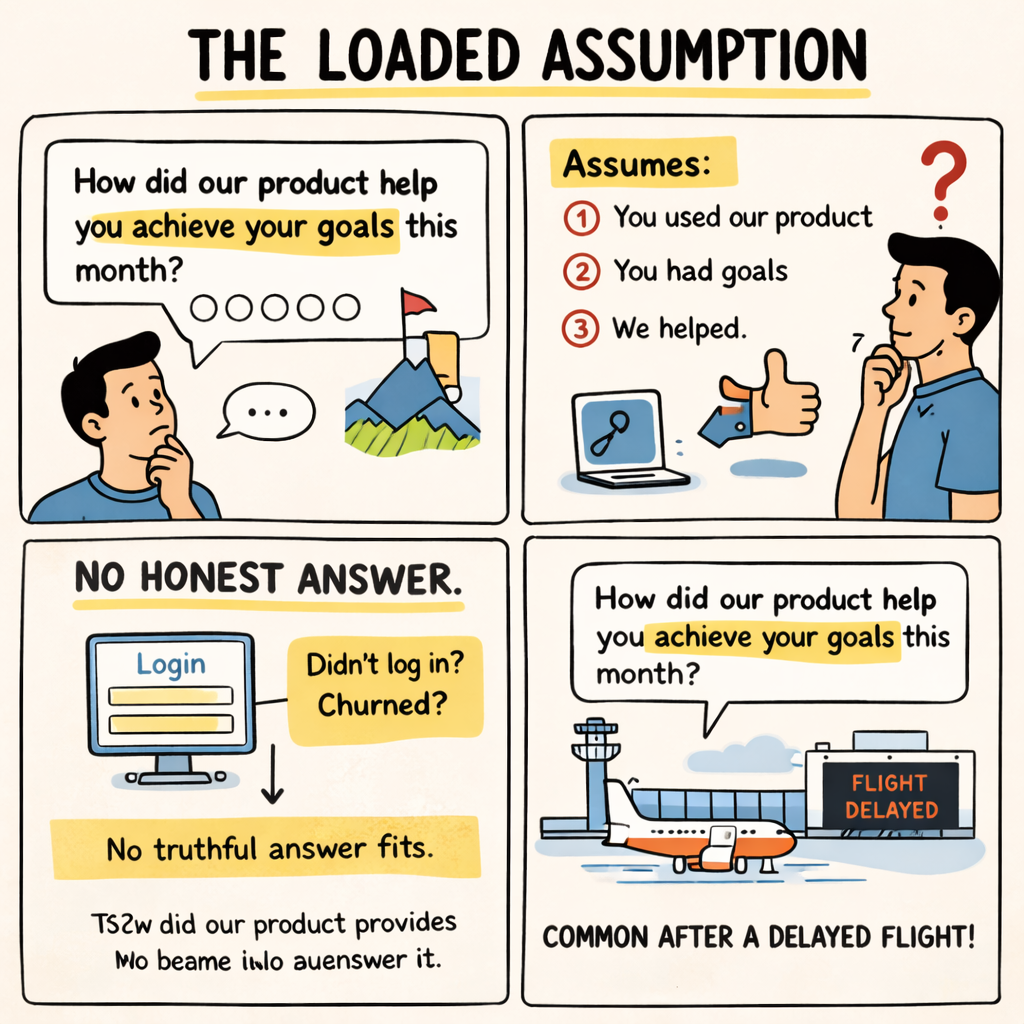
What does a recently churned user do with this question? What about a new user who hasn't gotten to value yet? What about someone whose company shifted priorities halfway through the month? There's no box to check. No option that fits. The result is either abandonment or a forced answer that poisons your data.
This one shows up constantly in post-flight surveys ("How did our service help make your journey smoother?") and unfortunately also in SaaS renewal flows. Common after delayed flights, as someone once noted - with full awareness of the irony.
Don't assume anything - let Elvin start with a blank slate and find out what your users actually did this month. Try Product Fruits now - for free!
#4: The "Obviously Yes" Question
"Do you want to save money?"
...Yes. Obviously. Next question. This is the survey equivalent of asking "do you like being happy?" It has a 100% yes rate. It has never once, in the history of customer feedback, produced a "no." And yet it appears in financial services and insurance products constantly—usually as a segmentation trigger designed to funnel people toward a sales pitch, not to gather genuine insight.
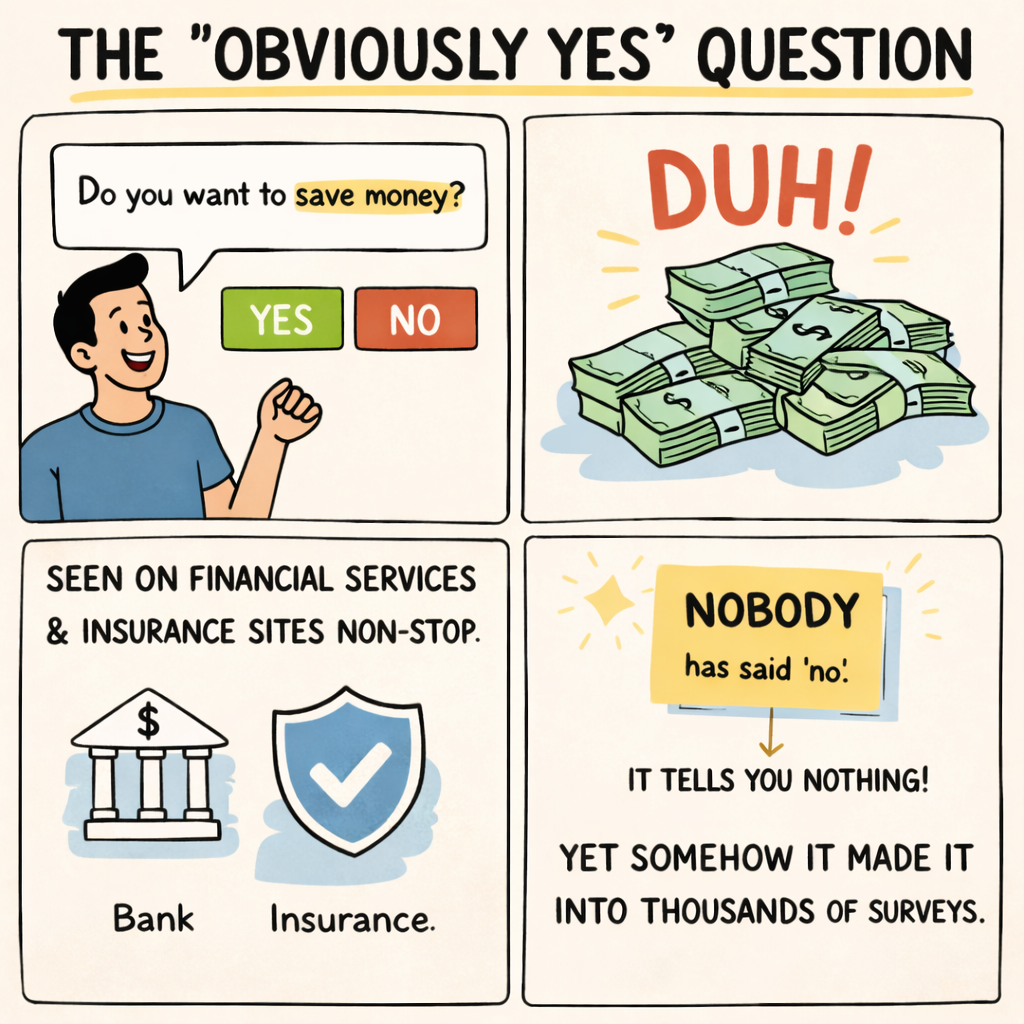
It tells you nothing about behavior, motivation, or willingness to act. It's not research. It's a rhetorical device wearing a survey's clothes.
With Product Fruits, it is easy to ask something nobody can answer with a reflexive yes. Elvin specializes in questions worth asking. Try Product Fruits now - for free!
#5: The Passive-Aggressive Scale
Options: Strongly Agree / Agree / Agree Somewhat / Agree a Little / Neutral
No. Negative. Options. At all. Technically, this is a scale. Functionally, it's a trap. When the lowest score someone can give you is "neutral," you've engineered your feedback to be incapable of capturing dissatisfaction. You'll report internally that 100% of responses were positive or neutral. You'll feel good about it. Your users - the ones who wanted to say they disagree, or strongly disagree—will quietly close the tab and start evaluating your competitors.
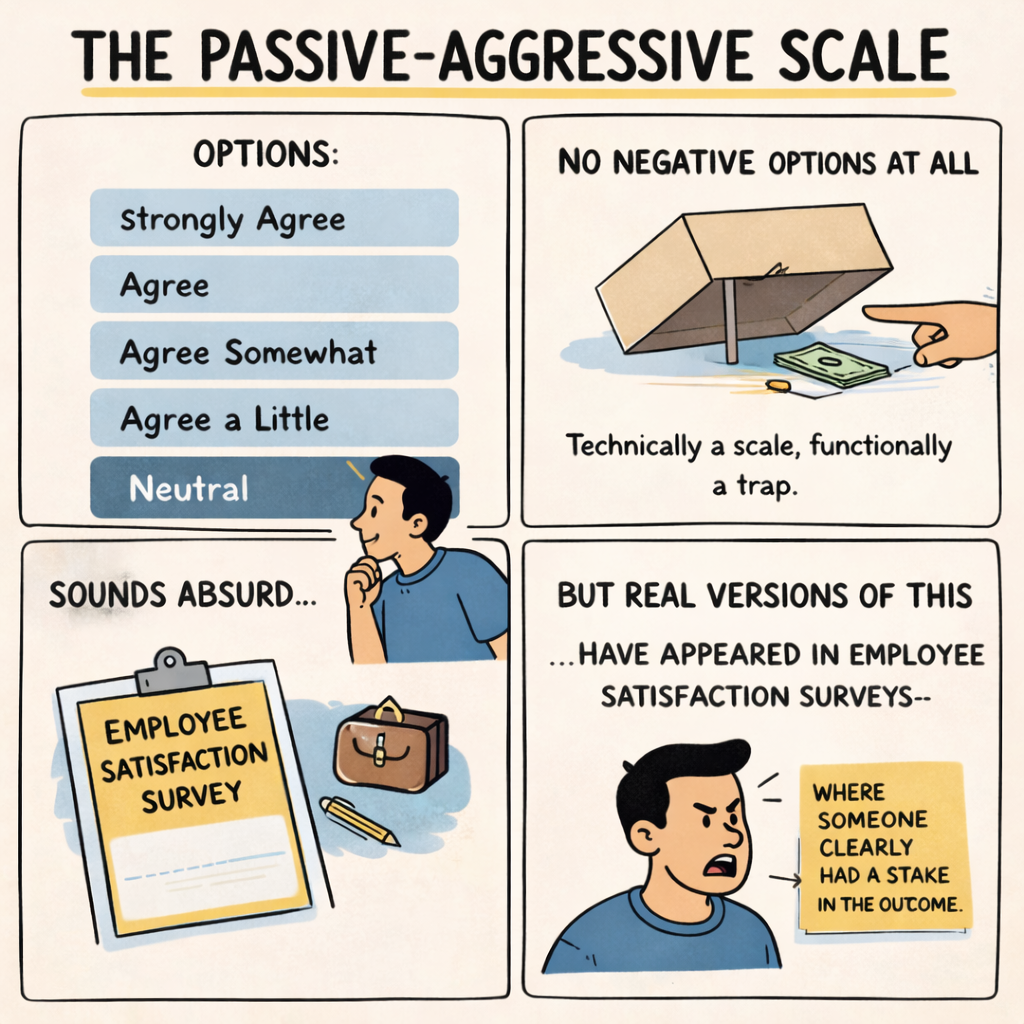
Real versions of this have appeared in employee satisfaction surveys. Actual companies. Where someone clearly had a stake in the outcome. Give your users a real voice. Elvin doesn't do forced positivity - just honest conversations. Try Product Fruits now - for free!
So Why Does Any of This Matter?
Because survey design is product strategy. The questions you ask shape the decisions you make. And if you're relying on surveys as your primary window into why users behave the way they do - why they churn, why they don't adopt a feature, why activation rates are stalling - you're working with a tool that has some real structural limitations.
Surveys are genuinely useful for quantitative signals: NPS tracking, CSAT benchmarks, yes/no feature validation. They're less suited for the why behind behavior. Fixed question paths lose nuance. Branching logic has limits. And even the best-designed survey can't follow up on a surprising answer the way a human researcher would.
That gap - between the signal surveys give you and the root-cause understanding you actually need - is exactly the problem that Product Fruits Discoveries is built to close.
A Different Approach: Let Elvin Ask the Questions
Product Fruits recently launched Discoveries, an AI-powered feature that approaches user research more like a conversation than a questionnaire. Instead of you designing a fixed set of questions (and hoping you don't accidentally write a loaded assumption or a passive-aggressive scale), you describe the problem you're trying to understand - low feature adoption, high drop-off at a specific step, unclear onboarding friction - and Elvin, the AI built into Product Fruits, takes it from there.
Elvin generates research topics based on your goal, asks your users adaptive questions in-app, and adjusts each follow-up based on what the user just said. No two conversations are the same. No user gets a question that doesn't apply to them. And when enough responses come in, Elvin synthesizes the raw conversations into a structured insight report -narrative plus quantifiable findings - that's actually actionable.
The short version: you don't have to be a user research expert to avoid the mistakes above. You just have to be clear about what you want to learn.
The Real Cost of Bad Questions
Here's what stings most about the five questions above: they don't fail loudly. They fail quietly, with high response rates and clean-looking charts. The data looks fine. The scores look decent. And meanwhile, you're building on a foundation of polite non-answers.
If you're a product lead trying to understand why a feature isn't getting traction, a CSM lead wondering why certain segments are at churn risk, or a SaaS founder trying to understand your first hundred users - the quality of your questions matters as much as the quantity of your responses.
Ask better questions. Or better yet, let Elvin AI in Product Fruits help you figure out what and how to ask in the first place.
Product Fruits Discoveries is currently available in Early Access. Try Product Fruits now - for free!


Weekly newsletter
Get the latest releases, tips, articles, and exclusive interviews delivered to your inbox weekly—no spam!