Product Fruits vs Appcues vs Pendo: which product adoption tool delivers the best ROI in 2026?


TL;DR
- Product Fruits offers transparent, MAU-based pricing starting at $111/1500 MAUs per month (or roughly $3,500 to $12,000 a year at midmarket 10,000 MAUs) with the Elvin AI assistant included. Best fit for teams that want fast time-to-value and real support deflection without an enterprise budget.
- Appcues stayed a focused, polished no-code builder with native mobile SDKs. Public entry pricing starts around $249 a month, and mid-market contracts run $12,000 to $40,000 a year. Best for frequent, multi-channel onboarding experiments.
- Pendo is now a broad product-operations suite with agentic AI (Agent Mode, Pendo Predict) layered onto deep analytics. Paid plans run roughly $15,000 to $142,000 a year and are quote-only. Best for enterprises that live in behavioral data.
- The two 2026 differentiators are AI support deflection and orchestration. Product Fruits customers like Mystore resolve about 60% of support inquiries autonomously with Elvin, and connect onboarding, in-app messaging, surveys, and support into one no-code Flows canvas. Appcues gates multi-channel messaging behind an add-on, and Pendo's Journey Orchestration is a premium enterprise module.
- There is no universal winner. The right tool depends on your MAU count, budget, and whether your priority is guidance, analytics, or automated adoption at scale.
You just signed for a product adoption platform. The deck promised seamless onboarding and users who guide themselves. Three months later you are stuck in implementation, your team cannot read the analytics, and the invoice came in higher than budgeted. Sound familiar?
Choosing between Product Fruits, Appcues, and Pendo is not really about the feature checklist. It is about return on investment: will this help you hit your numbers without breaking the bank? This guide breaks down the real ROI story for 2026, with transparent pricing, present-day product facts, and case studies with hard numbers.
What does "ROI" actually mean for product adoption tools in 2026?
ROI from a product adoption platform comes from five measurable levers:
- Activation and adoption lift that drives revenue or productivity.
- Support ticket deflection through self-serve content and AI.
- Reduced engineering time to build and maintain in-app experiences.
- Less manual operations work through automation, so one person can run onboarding, messaging, and feedback loops that used to need a team.
- Lower total cost of ownership at your actual monthly active user (MAU) count.
That fourth lever is where 2026 separates the field. The value is no longer in owning tours, banners, and surveys as separate features. It is in connecting them into automated, behavior-aware journeys that run at scale without adding headcount.
Here is the 2026 positioning at a glance:
- Appcues stayed deliberately narrow. It is a focused product-adoption vendor with the widest range of no-code in-app patterns and native mobile SDKs. Appcues applies AI to creation and execution, so it is quick to value if your goal is launching good onboarding this quarter.
- Pendo went the other direction and became a broad product-operations suite. Agentic AI now runs through it (Agent Mode, Agent Analytics, Pendo Predict) on top of retroactive analytics and session replay. Powerful, but you adopt more surface area and more cost.
- Product Fruits pairs transparent MAU-based pricing with the built-in Elvin AI assistant and Flows, a single no-code canvas that connects onboarding, in-app messaging, surveys, and support routing into one automated system. Non-technical teams branch on user behavior, read and write user properties, and trigger integrations like Slack, all without a developer. This orchestration ships inside the plans, not as a premium module or an add-on. Despite being powerful, Product Fruits users frequently report having first tour or announcement prototypes up and running in hours and more advanced Flows implementations in days.
Video mystore - why we chose Product Fruits
What will you actually pay at 2,500, 10,000, and 50,000 MAUs?
Nothing derails ROI faster than surprise costs. Here is the transparent version.
Appcues: public entry tiers, custom at scale
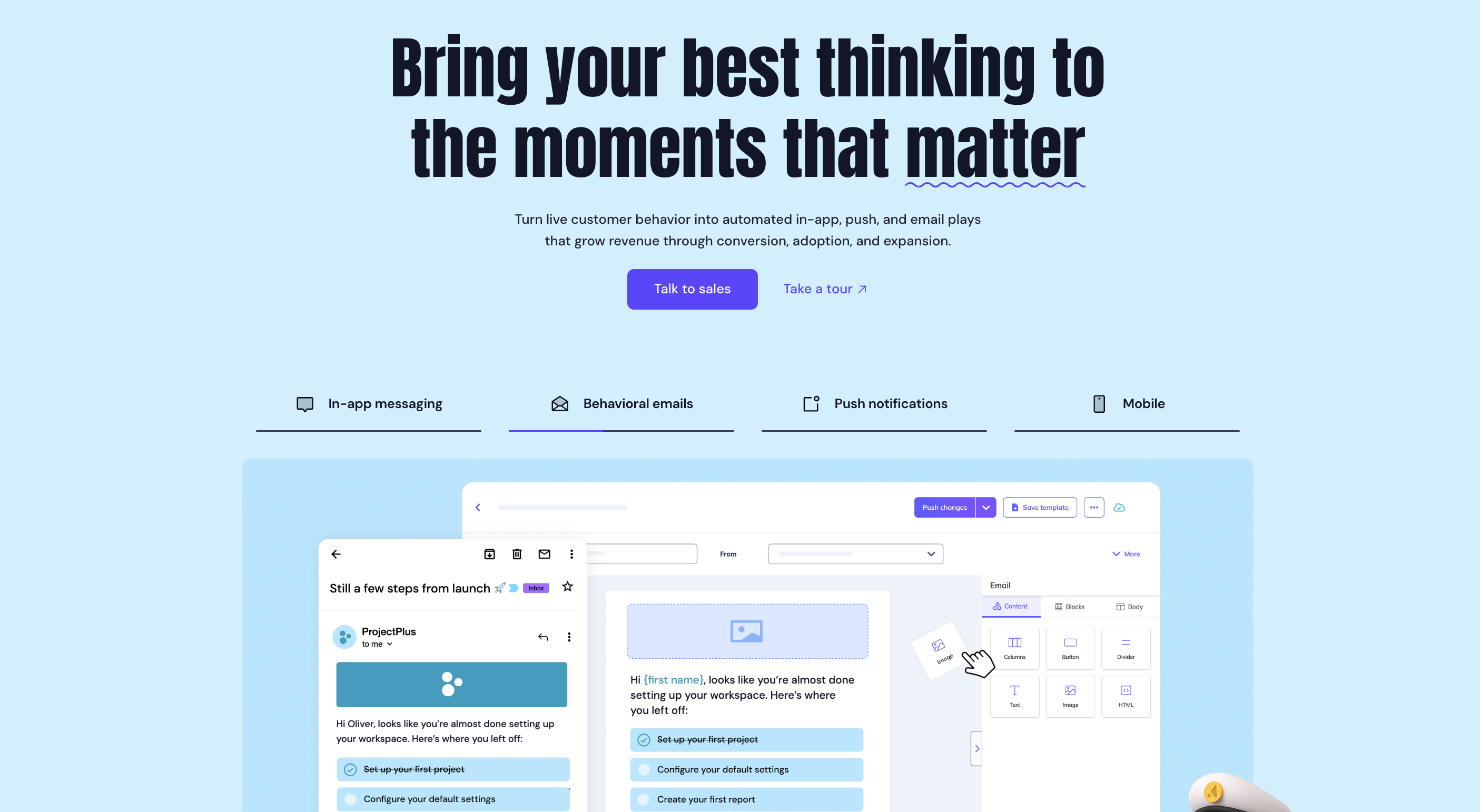
Appcues prices on MAUs across three tiers (Essentials, Growth, Enterprise), and you can show unlimited flows within your tier.
- 2,500 MAUs: Essentials starts around $249 a month, with Growth around $879 a month depending on the features you need.
- 10,000 MAUs: contact sales. Vendr marketplace data across real purchases puts mid-market buyers (5,000 to 25,000 MAUs) at $12,000 to $40,000 a year.
- 50,000 MAUs: Enterprise quote required.
Watch for non-linear scaling. Doubling MAUs more than doubles cost, and add-ons like mobile installation and premium messaging raise total contract value.
Pendo: free up to 500 MAUs, quote-only after that

Pendo Free covers up to 500 MAUs with analytics, in-app guides, NPS, and roadmaps. Cross that line and you cannot create new guides, surveys, or segments until you upgrade, and your reports fall back to sampled data.
- 2,500 MAUs: the free plan runs out fast. Paid contracts are five figures annually.
- 10,000 MAUs: mid-five figures is common. Vendr reports a mid-market average around $47,000 a year.
- 50,000 MAUs: high five to six figures, especially with session replay, orchestration, or data-residency requirements. Average enterprise spend runs into the low six figures.
All paid Pendo plans are annual, with no monthly option, and multi-year commitments are how you unlock the lower effective rate.
Product Fruits: transparent slider, AI included

No sales call required. The pricing slider shows the numbers upfront.
- 1,500 MAUs: $111 to $374 a month (yearly billing).
- 5,000 MAUs: $224 to $674 a month.
- 10,000 MAUs: $299 to $974 a month, with up to 2 500 Elvin AI conversations included and an additional $37 per 100 conversations.
- 50,000 MAUs: higher tiers on the slider, with Enterprise quotes for SSO, SLAs, and larger AI resolution pools.
At 10,000 MAUs, side by side
Pendo and Appcues quotes vary widely by modules, seats, and negotiation. Always get multiple quotes at your MAU band.
How fast can each tool get you to first value?
Time to value maps directly to ROI. The faster your team ships, the sooner the tool pays for itself.
- Appcues: hours to a few days for straightforward onboarding flows. Deeper segmentation or custom events add time.
- Pendo: analytics flow in within hours for a pilot, but full enterprise rollouts with governance and orchestration can take weeks to 90 days.
- Product Fruits: add a snippet or deploy through Google Tag Manager, then build in the visual editor. Many teams publish their first tours and checklists within hours.
Mystore, Norway's largest e-commerce platform, put a hard number on it. "It took me just a couple of minutes to build and deploy a first tour," said Trond-Daniel Kastnes Kvalvik, Product Manager and Team Leader. Their proof of concept was live in under an hour, compared to the days it took with a competitor they had tried (Mystore case study).
Which features move ROI the most in 2026?
1. AI support deflection
This is where Product Fruits pulls ahead. The Elvin AI assistant answers "how-to" questions directly from your knowledge base and docs in real time, and generates guidance on the fly. It is also uniquely able to learn and understand your app through annotations (and can thus function even without a knowledge base). When it genuinely cannot help, it drafts a structured escalation to a human with full context.
The results are concrete, not theoretical. Mystore routes every support conversation through Elvin first, and within 90 days it autonomously resolved close to 60% of inquiries with no added headcount. "Elvin has been a massive success for us," Kvalvik said. "It's not just a tool, it's a total shift in how we scale."
The math is simple. If your team handles 1,500 tickets a month at $15 each and you deflect a conservative 25%, that is about $67,500 a year saved. Against a Product Fruits cost near $5,000 a year at 10,000 MAUs, the deflection alone can return more than 13x. Appcues and Pendo rely on static tours and guides, so they reduce some tickets but do not answer novel questions from your live docs.
2. Flows: onboarding, messaging, surveys, and support in one automated system
This is the biggest gap between the three tools, and it favors Product Fruits. Owning tours, banners, and surveys as separate features is easy. Connecting them into automated, behavior-aware journeys that run at scale is not, and it is exactly what Flows does.
A Flow is a visual canvas where you branch on user properties, read and write those properties, wait for real behavior, trigger integrations like Slack, and route users into surveys or support, all without a developer. It turns onboarding, in-app communication, feedback, and support deflection from four disconnected features into one connected system that a non-technical team can run.
Mystore runs its entire feature-release process on a single Flow-based workflow: a segmented banner announces a beta, a guided tour triggers on first visit, a survey fires after 10 interactions and posts results to a developer Slack channel, a countdown warns before a legacy feature retires, and a welcome modal lands on switchover day. Beta enrollment is fully self-service too. A Flow checks a pilot_customer property, opts users in or out, updates the segment, and starts serving beta experiences automatically. "It's all up to the customers. We don't have to do anything," Kvalvik said. That flow took about 10 to 15 minutes to build.
Neither competitor matches this at the same price or without engineering. Appcues gates multi-channel messaging (Appcues Connect) behind a paid add-on, and Pendo's cross-channel Journey Orchestration sits in its premium enterprise tier. With Product Fruits, this orchestration is included.
Capability
3. Analytics depth
Pendo leads here, and it is not close. Retroactive event tracking, funnels, session replay, and now predictive adoption signals through its AI agent layer make it the choice for teams that want data to drive every guidance decision. Appcues focuses on experience creation and pairs with Amplitude, Mixpanel, or Heap for product-wide analysis. Product Fruits gives you built-in flow analytics (completion rates, paths, tour performance) that are enough to optimize onboarding, plus your existing analytics stack for the deep behavioral work.
The takeaway: Product Fruits wins on AI deflection and on orchestrating adoption at scale in one no-code system, Appcues on polished multi-channel UX, Pendo on analytics depth.
How do real results compare?
Pendo (396% ROI, Forrester TEI): A Forrester Total Economic Impact study found a composite enterprise achieved $3.81M in benefits over three years against $765,000 in costs, a 396% ROI (Forrester TEI). Note the context: this is a 35,000-employee organization using Pendo for internal employee software adoption, and the upfront investment is enterprise-scale.
Appcues (22x feature adoption): In a Litmus feature launch, 62% of users who saw an Appcues tooltip became active users of the feature, versus 2% in the control group, a 22x lift (Appcues case study). It is a targeted experiment for one feature, not a blanket guarantee.
Product Fruits (60% autonomous support resolution): Mystore resolved roughly 60% of support inquiries with Elvin in 90 days across 1,600+ stores. Two more customers show the same pattern. Adeus deployed its Elvin assistant ("Ady") in about 60 minutes and now handles roughly 60% of queries end to end, pulling from both its knowledge base and public website. Outsmart unified support in-app, connected its feedback widget to Jira, localized help into four languages, and lifted resolved tickets by 26%.
Note on the case studies: Adeus and Outsmart originally delivered in-app help through the Life Ring Button. That help hub is now the Elvin widget, which is the primary user-facing support surface across Product Fruits today.
What do real users say? (G2 and Capterra)
Social proof matters, especially on in-app messaging where day-to-day usability decides ROI.
Product Fruits reviewers consistently highlight the in-app messaging and self-serve angle. Reviewers note that guided tours, tooltips, and announcement banners work well for step-by-step training, and that the built-in "What's New" hub makes release notes feel professional and easy to track by audience. A recurring theme: Customer Success and Support teams can build and launch most content without waiting on Product or Engineering (Capterra reviews).
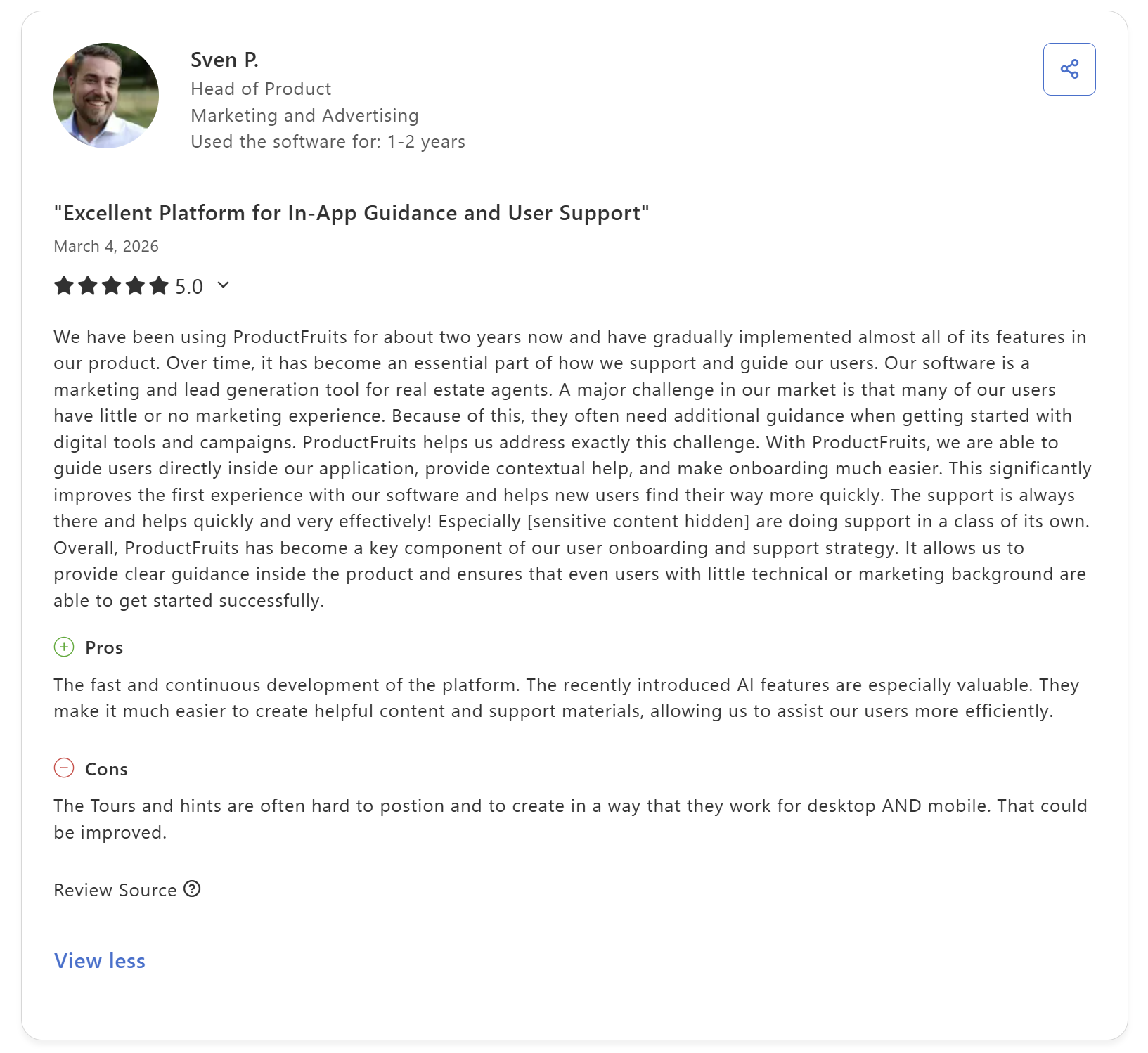
Appcues earns praise for a polished builder and fast setup, with occasional notes about flow-builder bugs. Pendo is loved for analytics depth, with a common complaint that it takes more than a few days to learn.
Can you migrate from Appcues or Pendo without losing work?
Yes, usually in one to three weeks.
- Audit and map (week 1): export your existing flows, checklists, and resource-center items, then map each pattern one-for-one to Product Fruits equivalents.
- Rebuild and connect (weeks 1 to 2): rebuild key flows in the visual editor, recreate segments from events or CRM data, and point Elvin at your knowledge sources so it can answer from your content.
- Test and roll out (weeks 2 to 3): QA in staging, run both tools in parallel with a small cohort, watch completion and deflection metrics, then cut over.
Most teams report a faster setup with Product Fruits than their original implementation, partly because Flows and Elvin remove work that used to need engineering. Mystore actually migrated from a stack that included Appcues, consolidating tours, announcements, knowledge base, and AI support into one platform.
Quick picker: which should you choose?
Choose Product Fruits if you want AI support deflection plus one no-code system to orchestrate onboarding, messaging, surveys, and support, fast time-to-value, and transparent pricing. Ideal under roughly 25,000 MAUs, or scaling toward 50,000+ and wanting predictable economics without the "contact sales" run-around.
Choose Appcues if you want the most polished no-code builder with the widest range of in-app patterns and native mobile SDKs, and you run frequent multi-channel onboarding experiments.
Choose Pendo if you need unified analytics and guidance at enterprise scale, with retroactive event tracking, session replay, and agentic AI insights, and you can fund the larger TCO and longer rollout.
FAQ
Is Appcues cheaper than Pendo in 2026?
Often yes at lower MAUs. Appcues posts public entry pricing starting around $249 a month, while Pendo paid plans are quote-only and run roughly $15,000 to $142,000 a year. At enterprise volumes both are custom, and the gap narrows. Your actual quote depends on MAUs, modules, and negotiation.
Does Pendo still offer a free plan?
Yes. Pendo Free covers up to 500 monthly active users, calculated from unique visitor IDs over 30 days, and includes analytics, in-app guides, NPS, and roadmaps. Once you pass 500 MAUs you cannot create new guides, surveys, or segments until you upgrade, and reporting switches to sampled data.
How does Product Fruits reduce support load?
The Elvin AI assistant answers users' how-to questions directly from your knowledge base and docs, inside your app. Customers report 25% to 30% fewer tickets from self-serve content alone, rising to around 60% of chat-originated questions resolved autonomously after tuning Elvin. When it cannot help, it drafts a structured handoff so the human agent starts with full context.
What are Product Fruits Flows, and how are they different from tours?
Flows are Product Fruits' next-generation guidance format, built on a visual canvas. Unlike a linear tour of cards, a Flow supports conditional branching, reading and writing user properties, wait steps, and action steps like triggering Slack messages or surveys. A Flow can replace a tour and also connect onboarding, in-app messaging, feedback, and support routing into one automated journey, all without code.
Can Appcues or Pendo do what Product Fruits Flows do?
Partly, but not in one included, no-code layer. Appcues builds polished linear flows and gates multi-channel messaging behind its Connect add-on. Pendo offers cross-channel Journey Orchestration, but only in its premium enterprise tier and with a steeper learning curve. Product Fruits Flows bundle branching logic, property read/write, integrations, and support routing into the base plan, so a non-technical team can automate adoption at scale without buying up a tier or waiting on engineering.
Which tool has the best analytics?
Pendo, clearly. It offers retroactive event tracking, funnels, session replay, and predictive AI insights natively. Appcues focuses on experience creation and integrates with Amplitude or Mixpanel for depth. Product Fruits provides built-in flow analytics that are enough to optimize onboarding, and pairs well with your existing analytics stack for behavioral analysis.
Which product adoption tool has the best ROI for a growing SaaS?
For most SMBs and mid-market teams under 25,000 MAUs, Product Fruits tends to deliver the strongest ROI because of transparent pricing and included AI deflection. At 10,000 MAUs you might pay around $5,000 a year versus $12,000 to $40,000 for Appcues or more for Pendo, and the AI can deflect enough tickets to fund the subscription many times over.
The bottom line
There is no universal best tool, only the best tool for your MAUs, budget, and priorities in 2026. Product Fruits delivers the lowest total cost of ownership and the fastest AI-assisted time to value, and it is the clear pick if you want to build in-app guidance fast, if your support team is drowning in "how do I" tickets and your CFO cares about ROI. Appcues wins for rapid, polished, multi-channel experiments. Pendo earns its higher cost when enterprise analytics and governance are non-negotiable. Want to see what Elvin and Flows could do on your own product and MAU count? Try Product Fruits for free or book a demo.
This article was originally published in December 2025, it was updated in July 2026.


Weekly newsletter
Get the latest releases, tips, articles, and exclusive interviews delivered to your inbox weekly—no spam!